
Panel 14
A Retrospective on my Visit to the Vietnam war memorial on 11 April 1990
In the spring of 1968, I had the good fortune to be hospitalized in Vietnam. Good fortune being equally divided between safely getting my rear end out of Vietnam and meeting Butch Skillman. We were both lieutenants and patients. About the time I met Butch, the war ended for me. I went home; back to “The World.”
I did not see much of Butch until the 1990s when he moved his family to Arizona while he pursued a Ph.D. in mathematics at the University of Arizona. Butch is my best friend; despite the fact we’ve met but a few times. The three-month stint we pulled at the 249th General Hospital in Japan joined us at the hip like we were born in Siam.
We hatched a plan to travel to the Vietnam War Memorial in Washington, D.C. during his spring break from teaching duties at South Dakota School of Mines. Our conversations during the drive from Rapid City to Washington, D.C. speculated on possible emotional effects of the visit. It was like sitting around the fire telling ghost stories on a Boy Scout camp out.
The morning after we arrived in Washington, we drove to the Memorial. We checked each other out with the same nervous chit-chat and gestures typical of our pre-combat assault jitters as young platoon commanders and forward observers. Like waiting to be picked up by helicopters for a Disneyland-like “E Ticket” ride, possibly to the Pearly Gates.
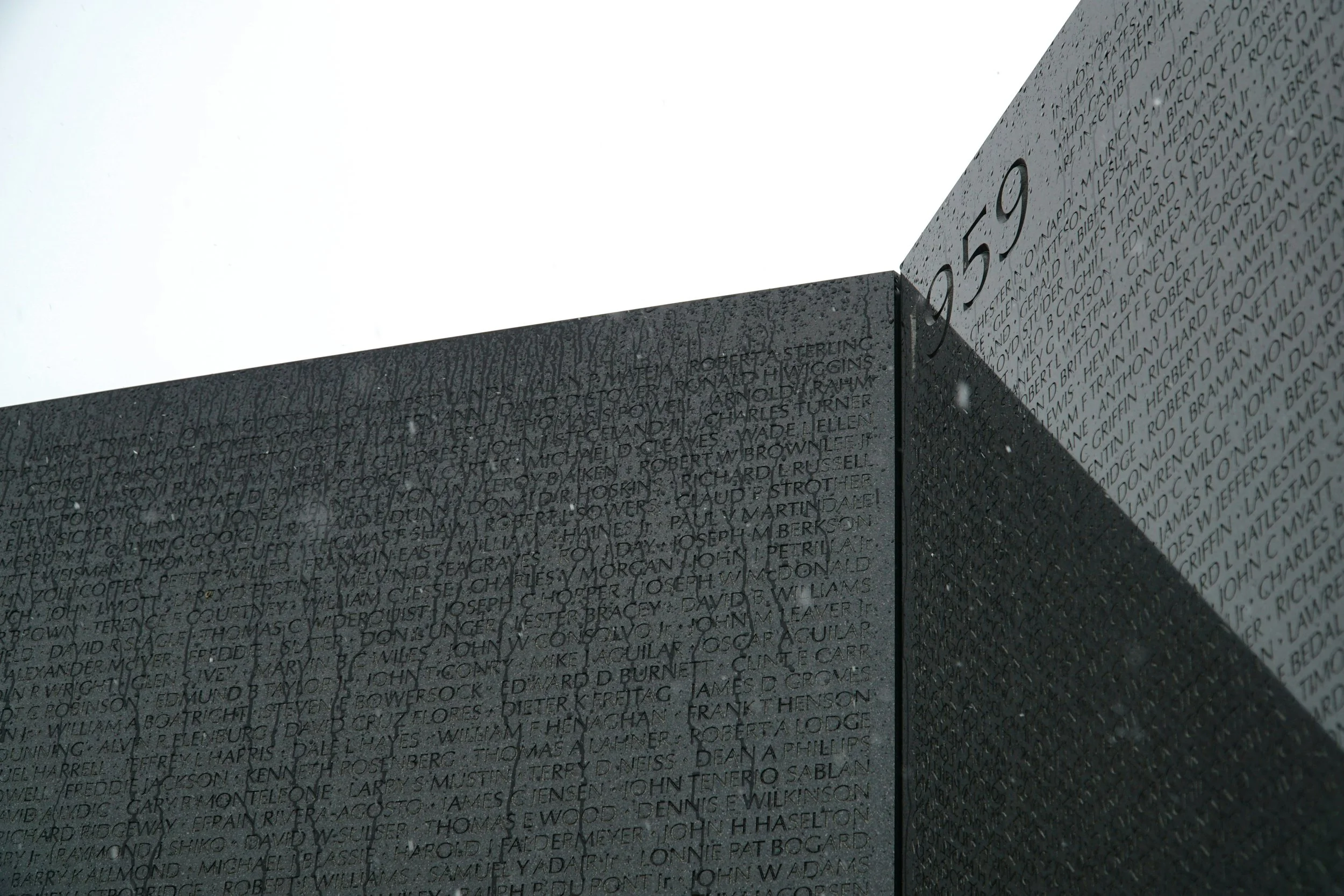
photo by Ian Hutchinson
Recalling memories of riding on a helicopter full of armed, frightened men, racing toward a hostile landing zone at treetop level at over 120 miles per hour, still makes my heart kick into passing gear. It doesn’t get much more exciting as one is never more alive than when he realizes his next breath could be his last.
In the distance, we viewed the majestic setting: Reflecting Pool and off to our right the Lincoln Memorial. The ground rose slightly away from the Constitution Avenue side.
I knew we were close to the Wall because of the silent procession slowly walking away, hand in hand, arm in arm. Faces reflected the solemnity of their experience.
My upper lip was covered with perspiration. I sniffled nervously and tasted the salt-rich liquid. I was point man as we started down the path into the bowels of the Memorial. My senses were in a Danger-Alert mode. Sniffing, listening, and seeing with a clarity only found this side of sensory overload. The Memorial jumped up at me like a skinned knee off hot pavement. I was in the middle of it before I could react. There was no time to warn myself or scream the alert, AM-BUSH.
The stacks of names anonymous in rank and branch of service were as oppressive as the unusual, early spring heat and humidity. Nearing the closest edge of the first of the series of name-laden granite slabs, I felt as if I was slowly descending into ever-deepening water. Goose flesh covered my arms and back. I shivered. The hair at the nape of my neck stood on end, reminding me of the reawakening of my base animal nature, dormant now for twenty-two years.
When I first encountered my ancient instincts, I thought I could smell a VC before I saw him. Today, I smelled nothing. I was immersed in the emotions of dread, betrayal, sadness, and loss. The excruciating sadness of the senseless sacrifice of such vital men and women. Which one of them took to his or her grave a cure for the AIDS virus or the skill to make their fellow man care enough to house and feed each other?
I searched a directory of names for known dead and those I hoped were not killed. I found Doug Fournet’s name on Panel 34. I touched the etching. My fingers softly traced each letter of: “Douglas B. Fournet.” I felt angry and sad. This lovely man was my roommate in Officers Candidate School (OCS). He was so full of life and hope for the future. He married shortly after OCS graduation. He was a good and dedicated husband and officer who died never having met his son.
I next searched for the location of the names of Robert Pullen and Daniel Wisely, both of whom were on the same panel since they were killed the same day. I searched for the name of the platoon leader who led my old platoon into the ambush, but he lived. I irrationally blamed him for Pullen’s and Wisely’s deaths and the other four dead as if my presence would alter the outcome. I wrongly believed they would not be dead if I remained in command of that platoon. An unreasoned conclusion but guilt has its own rules of construction.
On a nearby panel, I noticed the name John A. Greenfield. I worked closely with a Marine lieutenant named John Greenfield in the Combined Action Programs – “CAP Teams – CAP Lima.” When I saw the name, I remember shouting, “Oh, God no,” as I ran to the nearest directory to learn more about this John Greenfield. The deceased man was an Army corporal. My relief was whole. My Marine friend lived.
I did not reflect on the death of John A. Greenfield until the next morning. It saddened me to realize I felt nothing for this young man and the terrible effect of his death on his loved ones. Was he married, single, old, young, volunteer, or draftee? I did not appreciate the irony of trading the life of one John Greenfield for another – my friend for someone else’s.
I had promised myself I would not make a tracing of Doug’s name, but I made two. I sent one to my mother, since she pinned on his lieutenant bars our graduation day.
Throughout the visit to The Wall I felt the constant brooding omnipresence of the terrible and senseless waste of human life, and for what? Freedom? Bullshit! Eisenhower first and then JFK sold us down the Vietnam-commie-domino-flipping river. LBJ and Nixon doubled down further propagating the lie, as more names were etched in stone.
The war ended for me in May 1968. I stood in front of Panel 14, which corresponds to the approximate date of my departure from Vietnam. I stood about two-third’s way along the first of the Memorial’s two legs. Each leg extends two hundred seventy-six feet in length; and from one inch high at each end to over then feet tall at the center. The name of the first to die would nestle comfortably alongside the name of the last to die if the two ends were connected.
I did not realize two-thirds of the war’s dead or those declared missing in action, were lost after I left Vietnam. It was the year Nixon was elected president on an end the war with honor campaign. Forty thousand lives sacrificed for honor? Whose?
I was angry for not acting to stop the slaughter when I returned home. I didn’t protest. I didn’t march. I did throw my medals in the trash, but my mother repeatedly retrieved them. Instead, I crawled into my mental bunker to await the end of the unending-synapse-fracturing attacks of guilt.
The next evening Butch and I ate dinner on the patio at Phillips Fish Restaurant along the Potomac River. It was a lovely evening with a soft breeze. After dinner, we took a short cab ride to the Memorial and retraced our steps.
Night added a peculiar spirituality to the Memorial. Soft light reflected off the polished black granite surface. Fingerprints and lipstick smears were now visible on the lustrous surface, a testament to undying love.
The Wall contains no indication of rank or branch — only names. The ladder of death has no top nor bottom. It seems a sacred requirement each person represented on this wall appear here finally and eternally equal. A movie-star’s son name is next to a ghetto dweller, alongside a nurse, alongside a foreigner drafted into and serving in the U.S. military.
The Memorial did not mention my friend, Doug Fournet was posthumously awarded the Congressional Medal of Honor. This anonymity added to the purity of the stone tribute. Its shining skin so non-porous, but infinitely absorbent of the pain and emotions brought to it daily by friends and loved ones, ala a wailing wall.
We lingered until it was late like overstaying at an enjoyable party, but we understood our visit was complete. We said goodbye to our friends. I felt relieved and thankful I made the journey. I wasn’t granted absolution, but the experience was its own reward.
Butch and I swore a solemn oath if our government ever called his son, Matthew, to combat in a similar needless, egocentric war like Vietnam, we would do whatever was necessary to ensure Matt’s nonparticipation, even over his objection.
I said goodbye to Doug, Robert, Dan, and the others whose names I could not remember and the fifty-eight thousand, plus souls I never knew. Gradually, over the two-day visit, their grasp on me loosened and gently slipped away.
Amen.